
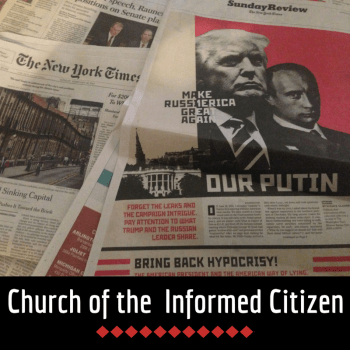
Church of the Informed Citizen: Feminism, feminization and more

Former FBI Director James Comey testified before the Senate Intelligence Committee this week, and he and the president basically (actually?) called each other liars. But as Maureen Dowd put it in the New York Times, “the president is not in any immediate jeopardy of being indicted or impeached.” Up next, Attorney General Jeff Sessions has agreed to testify before the committee Tuesday.

There has been a lot of reporting and analysis of Comey’s testimony. The Boston Review has an insightful piece dissecting how the president’s supporters have started attacking Comey with words that portray him as a woman. It’s a sad commentary that feminizing someone in this country amounts to demonizing, denigrating and dismissing them, but it’s true. If you are interested in good government, good citizenship, and ferreting out truth, pay close attention to the language used in debating issues and discussing news. Don’t let yourself get distracted from the real issues by this sort of sleight of hand.

Continue reading

Embracing democracy, nonconformity and kindness

Again, I am reading E.B. White. Having finished my umpteenth re-reading of One Man’s Meat, I’ve moved on to The Points of My Compass. Like One Man’s Meat, it feels like an old friend.

As with much of my non-fiction reading, it reminds me that my problems are not unique and my society’s struggles are not new. (I’m reminded especially of my reading of Langston Hughes’ writings a while back, and how sadly familiar were many of his themes). I’m both comforted and dismayed by the reminder.

Continue reading

Church of the Informed Citizen: More than the Paris climate accord

Regardless your position on the United States’ decision to pull out of the Paris agreement to combat climate change, How the GOP Came to View Climate Changes as Fake, in today’s New York Times, is an insightful look at the increasing influence of moneyed interests on American public policy and politics. Even Republicans who accept that climate change is real and believe we must act to stop it are largely afraid to speak up on the issue. Interestingly, among its other insights, this article tells us of a handful of GOP lawmakers who are hoping to buck that trend.

While Trump’s decision on the Paris accord fulfills a campaign promise, that doesn’t necessarily signal a trend. When his infrastructure plan comes out—it’s expected this coming week, although not with all the details in place—it won’t include nearly all the funding he talked about during the campaign. Cities, states and private businesses would have to pitch in to make up the difference: Details form the New York Times in Trump Plans to Shift Infrastructure Funding to Cities, States, Businesses.

Continue reading

Church of the Informed Citizen: May 28, 2017

The Church of the Informed Citizen—i.e., my house—held services today on the back deck in beautiful, sunny, spring-like Memorial Day weekend weather. Now, as the potatoes boil in preparation for the traditional potato salad of summer—and before I clean my house—here are a few recommended readings.

Two themes emerged for me today. One, inevitably, is the continuing expansion of the investigation into contacts and possible collusion between the Trump campaign and Russia. The other is children and how our governments serve or fail to serve them. Continue reading

Backward-running sentences and a character-filled cast

I have a new “Accidental Critic” piece up at Escape Into Life, a review of the book Cast of Characters, which examines the early years of The New Yorker magazine.

I hope you find it interesting, insightful, or some combination of the two. Without giving away the punch line, I can tell you that the book hasn’t yet been returned to the library because my husband now wants to read some or all of it. Fortunately, it’s not yet overdue.

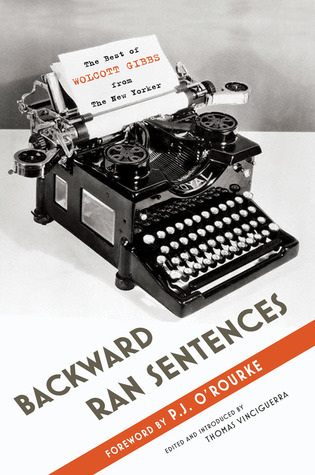
I followed up Cast of Characters by tracking down a collection of essays by (Oliver) Wolcott Gibbs, one of Harold Ross’ first and key hires at The New Yorker. I wanted to read his profile of Henry R. Luce, “Time… Fortune… Life… Luce,” which is most famous for one sentence in which Gibbs mocked the writing style in the Time magazine of his era: “Backward ran sentences until reeled the mind.” Continue reading