“Uprising: How Wisconsin Renewed the Politics of Protest, from Madison to Wall Street” – by John Nichols, Washington correspondent and blogger for The Nation magazine and associated editor of The Capitol Times in Madison, Wis. – is an interesting and thought-provoking read, both for the politically minded and for those interested in journalism and how to keep it alive as a vibrant force in American society.
The book is essentially an analysis of the protests that broke out when Wisconsin Gov. Scott Walker moved to strip public employees of their collective bargaining rights – and the impact the protest movement had nationwide. Nichols is perhaps uniquely positioned to write about this, as he has reported on both politics and media for years, and also lives and works in Madison.
I’m not going to go into a lot of detail about the book. It’s a short read, and you should just pick it up and read it for yourself. Here are some of the reasons why:
- Nichols pulls together many details of the Madison protests that you will have missed if you only followed them via mainstream media outlets.
- He paints a vivid picture of the breadth of the coalition that cropped up to oppose Walker’s plan. This was not just a protest by and for union members but one that drew in farmers, students and other Wisconsin residents concerned about economic fairness and the fate of the middle class.
- He shows how mainstream media got the story wrong – not just conservative outlets like Fox News but The New York Times as well. And he shows how creative, responsible and truthful citizen journalism – using social media and independent channels – provided a more accurate and timely picture. This should be an object lesson for all journalists, and anyone else who is concerned about the future viability of journalism.
- He quotes liberally from the writings of James Madison, Thomas Payne and other founding fathers, as well as Wisconsin’s own political forebears, to give historical perspective.
- His examination extends beyond the Madison protests, offering perspective on the senatorial recall efforts that followed, as well as the lessons that labor organizers took forward to use elsewhere and in the future.
- The book makes a great argument for my belief that the best way to ensure the viability of quality journalism is by “developing new models for creating and sustaining independent, not-for-profit media.” (Note his use of the word “not-for-profit;” that’s what the news business needs.)

 The year is 1914. Three sisters are driving a carriage down the street in Paterson, N.J., when an automobile appears and barrels straight into them, overturning their carriage, breaking it apart, and pinning them beneath it. When passersby scramble to right the vehicle and help free the sisters, oen of the sisters confronts the automobile driver and demands reimbursement for the damage done to the carriage.
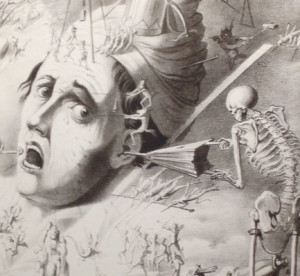 Machines that think are already among us. They’re also so far out in the future that they might never arrive.
 We have a bunny in our back yard. Or it might be a parade of several bunnies passing through on a regular basis. We have a pond, which attracts birds, bunnies and assorted other wildlife, and of course they attract other wildlife, including at least one hawk.